The Window of Tolerance – how do we as therapists talk about it with parents and school staff?
OK, so I’ve written one blog and then didn't go near them again! So I'm giving it another go.
As, so often I feel like I'm talking about the same thing that in the end, I thought “I need to get some of these ideas written down!” But I want to explain it in a conversational way, just like I do when I'm face to face because my favourite saying is always "just say it as it is" – who needs all the jargon?!

Now when I've seen the Window of Tolerance taught, it's always in the same way with the child in the middle of their "window" and us figuring out how to keep them there.
But here's the thing – children are still young. Still developing. How can they be expected to stay in their window without a trusted adult around?
So what is the Window of Tolerance?
If you've ever heard the phrase "oh he's on the edge" – like any minute a child could cry or tantrum, well that refers to the moment when someone (child or adult) is on the edge of their window of tolerance.
The actual window describes the zone in which a child or adult can think clearly, manage their emotions (they might be frustrated / sad but still managing this) AND stay connected with people around them. Inside the window, they are doing all of these things. Inside the window, we are calm, curious, able to handle a spilled drink or a change of plan without falling apart.
Outside the window, it's a different story. Above the window is hyperarousal (yeah sciency word) but that's where we shout, refuse or hit out. I always say to parents "have you ever said to your children 'if you carry on like that, I'll throw all your toys in the bin'". Well obviously, we're not going to do that! But in that moment, we as parents, have been pushed out and above our window of tolerance. This is when our Guard Dog is in flight or fight.
Then here's hypoarousal – this is below the window. When we go into shutdown, numb, spaced out, 'checked out'. When our children are talking to us and we are saying "mmm" in all the right places but not listening. Or when our child is seemingly ignoring us – that's when our guard is in 'freeze'.
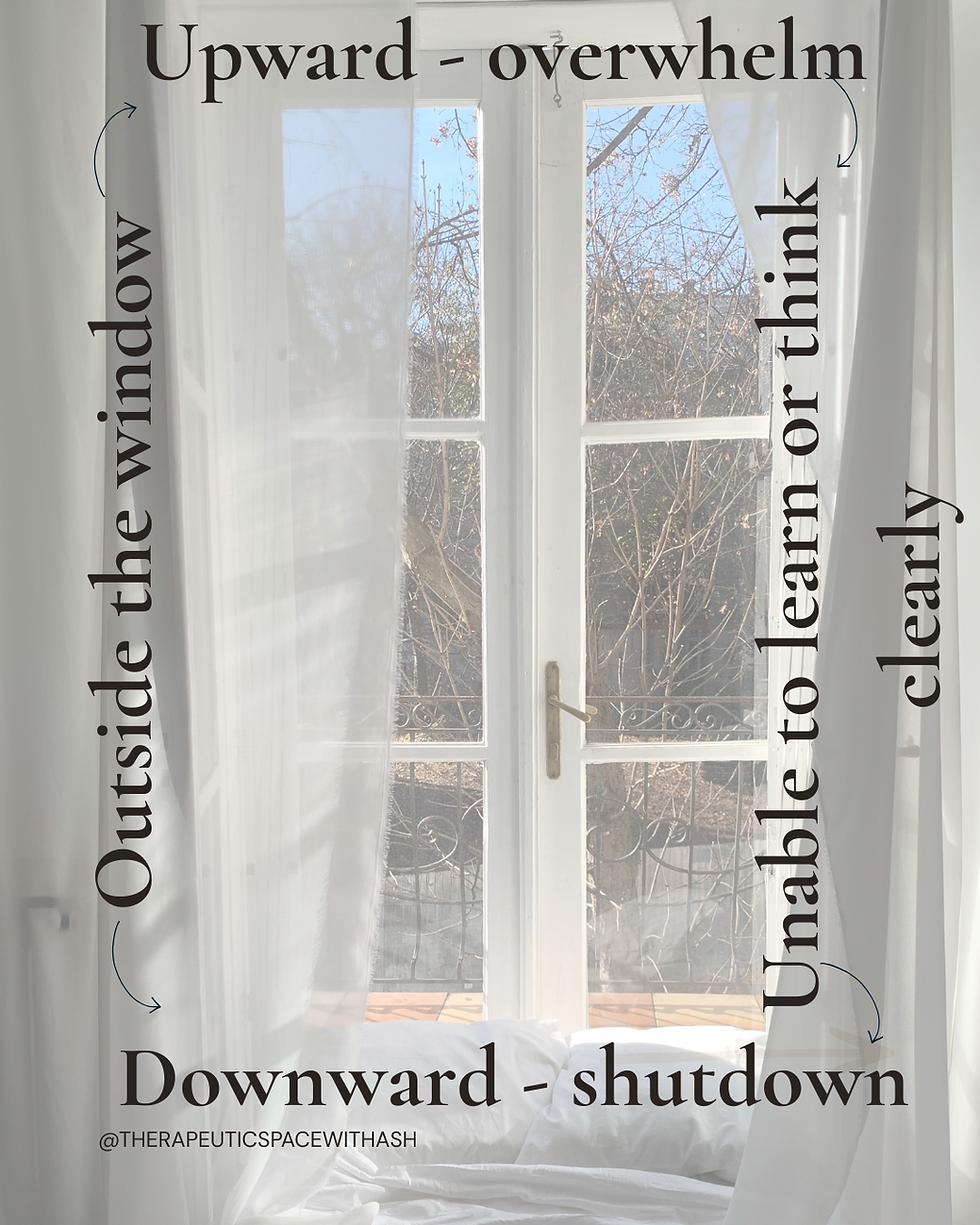
So basically, the Wise Owl flies out the window and the Guard Dog takes over, essentially to keep us safe. Only the Guard Dog can’t tell the difference between a lion about to eat us and a friend saying something nasty; it reacts to both.
Co-Regulation in the Window of Tolerance
But when I talk to parents and teachers about this window – the child isn't in the window alone. A regulated adult is right there next to them. Because a child can't come back into their window without a regulated adult.
So you know what's coming next – self-care!!
We need (as therapists, parents, school staff) to check in with ourselves before we even think about supporting a child.
A quick body scan – roll the shoulders, take the tongue from the roof of the mouth, relax the jaw, feel the ground as we walk over to the child who's screaming and shouting. If they see that we are nervous, anxious, stressed or annoyed - they'll know we are outside and on the edge of our window, not be able to co-regulate.
And the important part? Is remembering if they're not in their window, their wise owl has flown off. So, there is no point trying to teach them anything until they (and us) are back safely inside the window.
Where we are and where our child is within our window can change moment to moment or day to day. Neither them nor us can be expected to be in that window all the time. And the size of our window changes too – and how do we explain that?

When I'm on a beach, with the warm sun blasting down, the sound of the sea lapping on the shore and a good book in my hand – my window is HUGE! I'll tolerate anything then! But after a busy week, end of term, exhausted and hungry – my window is tiny, and I'm much more likely to snap!
But their windows mirror ours too – so if they feel that our window is small, theirs starts shrinking too.
How can we help?
It helps to figure out how to widen the window for both adult and child. A helpful idea is to work with the parent or school staff to figure out how they can:
· Notice their signals early.
· Know what calms their guard dog.
· Know what their Guard Dog needs more of daily – and make time for it!
· Don't try to repair until both wise owls are back in the window.
For more on this, keep an eye out for the Understanding the Brain Toolkit coming soon!
- Ash x


Comments